Messaging
The platform relays messages on a publish/subscribe basis between the modules. A message has a subject and a payload. The subject is what identifies the message to subscribers (as subscriptions are based on the subject) and the payload is the message content. Both the subject and the payload can be strings, indeed the payload is format agnostic.
However, the platform sets certain contracts/standards to adhere to in order for the various modules to recognise them.
More specifically, a subject must be of the format hub.<message type> and the payload must be in JSON format.
The exact structure of what message payloads to expect are detailed below.
Note that these are the default message payloads, they can be extended to include custom elements as described later in this article.
Below is an example flow of a message between two modules. In the diagram Module A is the publisher of the message and Module B is the subscriber.
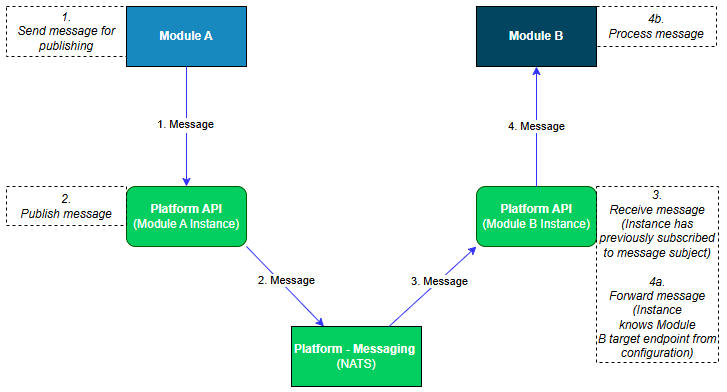
General Message Information
Independent of the message type, there is certain (meta) information about the message itself that is common to all messages.
This information needs to be included at the beginning of each message payload in the message element of the payload.
General Message Payload - Description
| Element Name | Required | Data Type | Description |
|---|---|---|---|
| version | Yes | integer | The version of the message payload. As payloads can be extended they are versioned each time so that any subscribers can consume it appropriately for said version. The Platform API rejects payloads without a version. Minimum value: 1. |
| id | Yes | UUID | The unique identifier for the message. Only necessary if a response message is expected from another module that needs to tie to this particular message and can thus, in conjunction with relatedId. If blank or the element is not specified then it is ignored. |
| relatedId | No | UUID | The unique identifier for the message that this message is a direct response to. Taken from the id from that message. Only necessary if a response message is expected from the requesting module. If the element is not specified then it is ignored and therefore assumed to not be a response to another message. |
| applicationId | Yes | string | The ID of the application publishing the message. This is useful in various scenarios including to enable the publishing application to ignore its own published messages if it also subscribes to messages of the same subject. |
| dateTime | Yes | date-time | This is the date and time of the message. An ISO 8601 formatted timestamp in UTC. Can be used by modules to distinguish between older and newer messages of the same subject, i.e. ordering. |
Message Types
This section describes the message payloads for different message subjects. This is the standard that messages in the platform adhere to.
Integration Message
The integration message is sent when a module seeks to be registered with the platform or its relevant API specification changes.
This is typically done when the module is first installed and configured.
The second scenario when this message type is sent is when a module’s API changes, e.g. new endpoints are added or existing ones removed or changed.
Finally, this message is also sent when a module is uninstalled and thus needs to be deregistered from the platform.
In this case, sending the message allows a graceful shutdown of the module within the persisting environment.
The integration message contains information about the module (currently only the applicationId) as well as information about the API endpoints
to get the information the other modules need in order to interact with the module.
This message is sent by the module that is seeking to register, i.e. make other modules aware of the integration.
For example, a module registering authorisation endpoints used by the IAM module.
Registration and Response Flow
When a module sends a registration message, consuming modules (such as the IAM Module) may process the registration and send back a response message.
This response message uses module-specific subjects with hub.integration subject as base by appending recipient’s applicationId (Example: hub.integration.examplemodule).
Key characteristics of the registration response:
- The response message includes a
relatedIdfield in the message section that references theidof the original registration message - The
integrationobject in a response contains onlytype(set to “registration”) andresponsefields - it does not includeendpointsorclientinformation - The
responseobject provides configuration information that the registering module needs to interact with the responding module’s infrastructure - Response messages are sent to module-specific subjects
Important: The registration response message should be processed only by the module that sent the original registration message.
Subject for integration: hub.integration
Subject for response: hub.integration.<applicationId>
Integration Message Payload - Registration Sample
{
  "message": {
    "version": 2,
    "id": "40009a87-fc31-49ff-88fb-707a7475150b",
    "applicationId": "MasterDataModule",
    "dateTime": "2025-08-13T14:30:00Z"
  },
  "integration": {
    "type": "registration",
    "endpoints": [
      {
        "purpose": "getRoles",
        "uri": "https://main.portal.rsh-masterdata.dev.suptech.regnology.io/api/v1/roles",
        "boundary": "external",
		"permissions": [
          {
            "roles": {
              "access": ["read:roles"]
            },
            "context": { "entities": ["E1"], "entityGroups": [] }
          }
        ]
      },
      {
        "purpose": "getRoles",
        "uri": "https://main.supervisioncenter.rsh-masterdata.dev.suptech.regnology.io/api/v1/roles",
        "boundary": "internal"
      },
      {
        "purpose": "getEntities",
        "uri": "https://main.supervisioncenter.rsh-masterdata.dev.suptech.regnology.io/api/v1/entities",
        "permissions": [
          {
            "roles": {
              "access": [ "read:entities" ]
            },
            "context": {
              "entities": [ "1" ],
              "entityGroups": []
            }
          }
        ]
      },
      {
        "purpose": "getEntityGroups",
        "uri": "https://main.supervisioncenter.rsh-masterdata.dev.suptech.regnology.io/api/v1/entityGroups",
        "permissions": [
          {
            "roles": {
              "access": [ "read:entityGroups" ]
            },
            "context": {
              "entities": [ "1" ]
            }
          }
        ]
      }
    ],
    "config": {
      "values": [
        {
          "key": "myKey",
          "value": "myValue"
        },
        {
          "key": "apiConfiguration",
          "value": {
            "version": "1.0",
            "supportedFormats": ["json", "xml"]
          }
        }
      ],
      "external": "s3://rhp/config/myConfig.xml"
    },
    "client": {
      "clientId": "masterdata-module-client",
      "rootUrl": "https://main.portal.rsh-masterdata.dev.suptech.regnology.io",
      "baseUrl": "/",
      "adminUrl": "https://main.portal.rsh-masterdata.dev.suptech.regnology.io/admin",
      "redirectUris": [
        "https://main.portal.rsh-masterdata.dev.suptech.regnology.io/*",
        "https://main.supervisioncenter.rsh-masterdata.dev.suptech.regnology.io/*"
      ],
      "webOrigins": [
        "https://main.portal.rsh-masterdata.dev.suptech.regnology.io",
        "https://main.supervisioncenter.rsh-masterdata.dev.suptech.regnology.io"
      ],
      "boundaries": [ "external", "internal" ],
      "permissions": [
        {
          "roles": {
            "access": [ "module::masterdata::access" ]
          },
          "context": {
            "entities": [ "1" ],
            "entityGroups": []
          }
        }
      ]
    }
  }
}
Integration Message Payload - Registration Response Sample
{
  "message": {
    "version": 2,
    "id": "7b8c9d2e-4f5a-6b7c-8d9e-0f1a2b3c4d5e",
    "relatedId": "40009a87-fc31-49ff-88fb-707a7475150b",
    "applicationId": "IAMModule",
    "dateTime": "2025-08-13T14:30:15Z"
  },
  "integration": {
    "type": "registration",
    "response": {
      "iamModuleApplicationId": "IAM-Module",
      "boundary": "internal",
      "apiBaseUrl": "https://main.portal.rsh-iam.dev.suptech.regnology.io/api",
      "clusterInternalApiBaseUrl": "http://iam-module-api.iam.svc.cluster.local:8080/api",
      "iamModuleSuperAdminRoleId": "super_admin",
      "keycloakBaseUrl": "https://main.portal.rsh-iam.dev.suptech.regnology.io/auth",
      "clusterInternalKeycloakBaseUrl": "http://keycloak.iam.svc.cluster.local:8080/auth",
      "keycloakRealm": "platform-realm",
      "clientId": "masterdata-module-client"
    }
  }
}
Integration payload structure (schema tree)
Overview of nested elements as defined by hub.integration.2 (current; message.version is required). The earlier hub.integration.1 schema marks message.version as optional, but the Platform API rejects payloads without a version regardless of the schema version selected by the producer. Registration messages typically carry integration.endpoints, integration.config, and integration.client; the registration response from the IAM module carries integration.response.
(root object)
├── message (object) — required
│   ├── version (integer, >0) — required
│   ├── id (string, uuid) — required
│   ├── relatedId (string, uuid) — optional
│   ├── applicationId (string) — required
│   └── dateTime (string, date-time) — required
└── integration (object) — required
    ├── type (string, enum: registration | deregistration) — required
    ├── response (object) — optional
    │   ├── iamModuleApplicationId (string) — required when response present
    │   ├── boundary (string) — required when response present
    │   ├── apiBaseUrl (string) — required when response present
    │   ├── clusterInternalApiBaseUrl (string) — required when response present
    │   ├── iamModuleSuperAdminRoleId (string) — required when response present
    │   ├── keycloakBaseUrl (string) — required when response present
    │   ├── clusterInternalKeycloakBaseUrl (string) — required when response present
    │   ├── keycloakRealm (string) — required when response present
    │   └── clientId (string) — optional
    ├── endpoints (array) — optional
    │   └── [each item] (object)
    │       ├── purpose (string) — required
    │       ├── uri (string) — required
    │       ├── boundary (string) — optional
    │       └── permissions (array) — optional
    │           └── [each item] (object)
    │               ├── roles (object, open keys → array of strings) — required
    │               └── context (object) — optional
    │                   ├── entities (array of strings) — optional
    │                   └── entityGroups (array of strings) — optional
    ├── config (object) — optional
    │   ├── values (array) — optional
    │   │   └── [each item] (object)
    │   │       ├── key (string) — required
    │   │       └── value (string | object) — required
    │   └── external (string) — optional
    └── client (object) — optional
        ├── clientId (string) — optional
        ├── rootUrl (string) — optional
        ├── baseUrl (string) — optional
        ├── adminUrl (string) — optional
        ├── redirectUris (array of strings) — optional
        ├── webOrigins (array of strings) — optional
        ├── boundaries (array of strings) — optional
        └── permissions (array) — optional
            └── [each item] (object)
                ├── roles (object, open keys → array of strings) — required
                └── context (object) — optional
                    ├── entities (array of strings) — optional
                    └── entityGroups (array of strings) — optional
Integration Message Payload - Description
| Element Name | Required | Data Type | Description |
|---|---|---|---|
| message | Yes | object | Information about the message. See General Message Information. |
| integration | Yes | object | Information about the module that is the context for the message, which is required for the module’s integration with the other modules. Which information is required to be shared by one module essentially depends on the other modules and their touchpoints with the respective module. |
integration
| Element Name | Required | Data Type | Intended Values | Description |
|---|---|---|---|---|
| type | Yes | string |
| The type of activity to be performed for the integrating module. It may be “registration” or “deregistration”. “Registration” makes the other modules aware of the module and its specifications. “deregistration” enables a graceful shutdown (of the module). |
| response | No | object | Contains IAM Module configuration information sent in response to a registration message. This field is only present in messages sent by the IAM Module as a response to a module’s registration request. When present, the message’s relatedId field will reference the original registration message. See the response field description table below for details. | |
| endpoints | No | array | The full list of API endpoints of the integrating module which are relevant to any of the other modules. It can contain an arbitrary number of items. Each item is meant to describe one API endpoint for a specific “purpose” and “boundary”, e.g. for the IAM module of the portal to be able to get a list of all roles defined in the sending module. The endpoints must be RESTful API endpoints and use the “POST” method and accept a body with permissions. Can be omitted if “type” is “deregistration”. Deregistration removes the representation of the entire module from the other modules of the environment, including all of its endpoints. | |
| config | No | object | Contains configuration information for the integrating module. This can include inline configuration values or a reference to an external configuration source. See the config field description table below for details. |
endpoints
| Element Name | Required | Data Type | Description |
|---|---|---|---|
| purpose | Yes | string | A categorisation for the type of data the endpoint is supposed to return in terms of what it will be used for. The specific purpose values and their meanings are defined by the consuming modules. |
| uri | Yes | string | The URI pointing to the respective API endpoint to retrieve the relevant data. It must be a valid URI. Required if “type” is “registration” and “endpoints” is provided and not empty. |
| boundary | No | string | Can be used to separate out distinct spaces that can each use a copy of the same endpoint - one for each “boundary” value. Other modules can use the “boundary” value to filter out the endpoints that are relevant to them. As an example, an “internal” and an “external” boundary could be defined to discriminate if the respective endpoint with the given specifications is to be used only for the supervision center (for regulator users) or only for the portal (facing supervised entities). In the case of information processed by the IAM platform module, for instance, only the respective (internal/external) instance will process the information. If the same URI shall be registered for both internal and external use, it needs to be provided as two separate endpoints with the same “uri” element - one with “internal” and one with “external” “boundary”. |
| permissions | No | array | An array of permission objects that specify the permissions required to access the respective endpoint. Each permission object may contain roles or a certain context. See the description of the “roles” and “context” in the table below. Permissions will not be overwritten in case of an update to an existing endpoint, but appended to the existing ones. In case permissions need to be overwritten, two messages need to be sent sequentially, where the respective endpoint is present only in the second (newer) one - together with the new permissions. |
config
| Element Name | Required | Data Type | Description |
|---|---|---|---|
| values | No | array | An array of configuration key-value pairs. Each item contains a key (string) and a value (object) property. This allows passing arbitrary configuration data inline within the integration message. The value property is an object type, allowing for flexible and structured configuration data to be provided for each key. |
| external | No | string | A reference to an external configuration source, such as a URL or path to a configuration file. This can be used when the configuration is too large or complex to include inline, or when the configuration is managed externally and should be fetched from a separate location. The format and interpretation of this field depend on the module’s implementation. |
values
| Element Name | Required | Data Type | Description |
|---|---|---|---|
| key | Yes | string | The configuration key identifier. This uniquely identifies the configuration parameter. |
| value | Yes | object | The configuration value. This is an object type, allowing for complex, structured configuration data to be provided. The structure depends on the specific configuration requirement. |
response
| Element Name | Required | Data Type | Description |
|---|---|---|---|
| iamModuleApplicationId | Yes | string | The application ID of the IAM Module. |
| boundary | Yes | string | The boundary context for which this response applies (e.g., “external” for portal, “internal” for supervision center). |
| apiBaseUrl | Yes | string | The externally accessible base URL for the IAM Module API. |
| clusterInternalApiBaseUrl | Yes | string | The cluster-internal base URL for the IAM Module API, used for service-to-service communication within the Kubernetes cluster. |
| iamModuleSuperAdminRoleId | Yes | string | The role ID for the super administrator role in the IAM Module, used for granting full administrative access. |
| keycloakBaseUrl | Yes | string | The externally accessible base URL for the Keycloak authentication server. |
| clusterInternalKeycloakBaseUrl | Yes | string | The cluster-internal base URL for Keycloak, used for service-to-service authentication within the Kubernetes cluster. |
| keycloakRealm | Yes | string | The Keycloak realm name that the module should use for authentication and authorization. |
| clientId | No | string | The OAuth2/OIDC client ID created for the registering module. If not provided, the client ID can be derived from the module’s application ID using the pattern applicationId-module-client. |
permissions
| Element Name | Required | Data Type | Description |
|---|---|---|---|
| roles | Yes | object | An object where keys are role type names and values are arrays of role IDs. The type names must match those defined in the module’s getRoles endpoint response. Together with the “context”, these roles will be used for authorization when requests to the respective endpoint are made. |
| context | No | object | The context that needs to be respected to successfully call the endpoint in the “uri” element. |
context
| Element Name | Required | Data Type | Description |
|---|---|---|---|
| entities | No | array | A list of entities that the requesting user has access to and that are required to successfully call the endpoint in the “uri” element. This element is optional. |
| entityGroups | No | array | A list of entity groups (like “bank” or “insurance”) that the requesting user has access to and that are required to successfully call the endpoint in the “uri” element. This element is optional. |
client
| Element Name | Required | Data Type | Description |
|---|---|---|---|
| clientId | No | string | The unique identifier for the OAuth2/OIDC client. This is used to identify the client application in authentication and authorization flows. Generated automatically as <applicationId>-module-client if omitted. |
| rootUrl | No | string | The root URL of the client application. This is typically the base domain or URL where the client application is hosted. |
| baseUrl | No | string | The base URL used by the client. This may be used as a fallback or default redirect location. |
| adminUrl | No | string | The admin URL for the client application. This can be used for administrative callbacks or notifications. |
| redirectUris | No | array | An array of valid redirect URIs for the client. After successful authentication, users will be redirected to one of these URIs. Each item in the array must be a valid URI string. |
| webOrigins | No | array | An array of allowed web origins for CORS (Cross-Origin Resource Sharing). These origins are permitted to make cross-origin requests to the authentication server. |
| boundaries | No | array | An array of boundary identifiers that define the operational context or scope of the client. Each item in the array must be a string. |
| permissions | No | array | An array of permission objects that define the permissions in IAM Module required for the client to operate (use IAM Module endpoints). Each permission object includes roles and context information similar to endpoint permissions. See the description of "roles" and "context" in the permissions table above. This allows fine-grained access control for the client based on user roles and context such as entities and entity groups. |
If in doubt when setting the client URLs (rootUrl, baseUrl, adminUrl, redirectUris, webOrigins), refer to Keycloak’s documentation for detailed guidance on client configuration.
The JSON schema for this payload is hub.integration.2 (current); the legacy hub.integration.1 schema remains supported for backward compatibility.
The schema is used by the Platform API to validate messages of this type/subject before being published.
Entity Message
The entity message is sent when there is new entity information to be shared, e.g. when an entity is licensed (via the Licensing module) or when its properties change (via the Master Data Management module).
Subject: hub.entity
Entity Message Payload - Sample
{
  "message": {
    "version": 2,
    "id": "40009a87-fc31-49ff-88fb-707a7475150b",
    "relatedId": "40bdad99-c18c-4246-bd41-60a04cea454f",
    "applicationId": "MasterDataModule",
    "dateTime": "2025-01-01T12:00:00Z"
  },

  "entity": {
    "reference": "PB123",
    "names": [
      {
        "locale": "en-GB",
        "name": "Peach Bank"
      }
    ],
    "status": "Active",
    "modules": [
      {
        "id": "CP",
        "version": "1"
      }
    ],
    "files": [
      {
        "type": "entity-data",
        "uri": "s3://rhp/entity-data/pb123.corporateProfile.xml"
      },
      {
        "type": "entity-schema",
        "uri": "s3://rhp/entity-schema/v4.corporateProfile.xsd"
      }
    ]
  }
}
Entity payload structure (schema tree)
Overview of nested elements as defined by hub.entity.2 (current; message.version is required). The earlier hub.entity.1 schema marks message.version as optional, but the Platform API rejects payloads without a version regardless of the schema version selected by the producer.
(root object)
├── message (object) — required
│   ├── version (integer, >0) — required
│   ├── id (string, uuid) — required
│   ├── relatedId (string, uuid) — optional
│   ├── applicationId (string) — required
│   └── dateTime (string, date-time) — required
└── entity (object) — required
    ├── reference (string) — required
    ├── names (array, unique items) — required
    │   └── [each item] (object)
    │       ├── locale (string) — required
    │       └── name (string) — required
    ├── status (string) — optional
    ├── modules (array, unique items) — required
    │   └── [each item] (object)
    │       ├── id (string) — required
    │       └── version (string) — required
    └── files (array, unique items) — optional
        └── [each item] (object)
            ├── type (string) — required
            └── uri (string) — required
Entity Message Payload - Description
| Element Name | Required | Data Type | Description |
|---|---|---|---|
| message | Yes | object | Information about the message. See General Message Information. |
| entity | Yes | object | Information about the entity (firm) that is the context for the message. |
entity
| Element Name | Required | Data Type | Description |
|---|---|---|---|
| reference | Yes | string | The unique reference/ID of the entity. This should not change over time, i.e. this should be unique and constant. |
| names | Yes | array | An array of entity name translations, i.e. one per language/locale. Items in the array must be unique. |
| status | No | string | The status, if any, for the entity, e.g. “Active”, “Inactive” or “Licensed”. The absence of a value or the element altogether indicates no status. |
| modules | Yes | array | An array of modules that apply to this entity. An entity always pertains to a single module (set of forms/templates). Items in the array must be unique which is guaranteed as in practice there should only be one. |
| files | No | array | An array of links to one file each containing the relevant data for the entity. This is an array as there can be more than one type of file containing data/information, e.g. entity data and a entity data schema. If not specified or the object is empty then it is assumed there are no files, i.e. no data (or no data being shared now/yet). |
names
| Element Name | Required | Data Type | Description |
|---|---|---|---|
| locale | Yes | string | The locale the name is in, e.g. en-GB. Must be in the format <language code ISO 639-1>-<country code ISO 3166-1 Alpha2>. |
| name | Yes | string | The name of the entity in the given locale. |
modules
| Element Name | Required | Data Type | Description |
|---|---|---|---|
| id | Yes | string | The ID of the corporate module, e.g. “CP”. |
| version | Yes | string | The version of the corporate module, ideally in the format <major>.<minor> e.g. 2.8 but in reality in whatever format the publishing application determines. |
files
| Element Name | Required | Data Type | Description |
|---|---|---|---|
| type | Yes | string | The type of the file relative to the entity. Known file types/allowed values are as follows:
|
| uri | Yes | string | The URI pointing to the respective file. It must be a valid URI including the full path to the file and the file extension. Files are stored in platform storage, in folders according to their purpose, e.g. entity data files in a folder named entity-data and entity schema files in a folder named entity-schema. The following conventions are known possible URI values: wasb is also accepted when reading an existing URI.abfs is also accepted when reading an existing URI. |
The JSON schema for this payload is hub.entity.2 (current) for an XML profile and hub.entity.3 for a JSON profile, see Version 3: JSON profile; the legacy hub.entity.1 schema remains supported for backward compatibility.
The schema is used by the Platform API to validate messages of this type/subject before being published.
Version 3: JSON profile
Datacollection publishes version 3 when it is the entity owner of a deployment. The envelope matches version 2. The files differ: entity-data holds the entity profile as JSON, and entity-schema holds the JSON Schema that the profile conforms to. Versions 1 and 2 carry the XML profile and the XSD that Licensing publishes, so a consumer selects its mapping by message.version before it reads the files.
{
  "message": {
    "version": 3,
    "id": "0d3c7a3e-5f0b-4d43-9a8e-1c2f4b6d8e10",
    "applicationId": "DataCollectionModule",
    "dateTime": "2026-10-15T09:41:07.312Z"
  },
  "entity": {
    "reference": "PEACH-BANK",
    "names": [
      { "locale": "en", "name": "Peach Bank" },
      { "locale": "sv", "name": "Persikabanken" },
      { "locale": "und", "name": "Peach Bank" }
    ],
    "status": "Active",
    "modules": [
      { "id": "bank", "version": "9b1f0c4e2d7a6b5c8e3f1a0d9c8b7a6e5f4d3c2b" }
    ],
    "files": [
      {
        "type": "entity-data",
        "uri": "s3://rhp/entity-data/mdm.bank.0d3c7a3e-5f0b-4d43-9a8e-1c2f4b6d8e10.json"
      },
      {
        "type": "entity-schema",
        "uri": "s3://rhp/entity-schema/mdm.9b1f0c4e2d7a6b5c8e3f1a0d9c8b7a6e5f4d3c2b.bank.schema.json"
      }
    ]
  }
}
Version 3 differs from version 2 in the following elements:
| Element Name | Version 3 |
|---|---|
| message.version | Always 3. |
| message.applicationId | The RSH module name of the publisher. Datacollection sends DataCollectionModule unless the deployment configures another name. |
| message.dateTime | UTC with milliseconds. The publisher takes it while it holds the lock of the entity, so a later change to the same entity has a later time as long as the clocks of its nodes are in sync. |
| entity.reference | The entity id in MDM. hub. carries the same id as entityReference. |
| entity.names | One item per language the entity type defines for its name, plus the fallback name under und, the code for an undetermined language. Other locale values are language codes as the content of the publisher defines them, for example en or de, not locales such as en-GB. Use the name in your language if there is one, otherwise the und name. The array is empty when the entity has no name. |
| entity.status | Datacollection always sends Active. |
| entity.modules | Required, with exactly one item. id is the entity type, for example bank. version is the content version that defines the schema of that entity type. |
| entity.files | Required. It holds exactly one entity-data file and exactly one entity-schema file. |
Every message carries the full state of the entity. Delivery is at least once and the order is not guaranteed, so a consumer follows these rules:
- It keeps only the newest message per
entity.reference, ordered bymessage.dateTime. A duplicate or a late redelivery then changes nothing. - It reads the schema from the
entity-schemaURI. The schema$idis a logical name, not an address. See Datacollection profile files. - It answers with a
2xxstatus to a version it does not handle. Any other answer makes the Platform API deliver the message again.
The JSON schema for version 3 is hub.entity.3.
Datacollection profile files
When Datacollection is the entity owner, it uploads one compiled JSON Schema per entity type, the locale files from that content, and an index each time it registers MDM content. The Platform API file type is entity-schema. Names are a single path segment so every storage provider keeps them:
mdm.<contentVersion>.<entityType>.schema.jsonmdm.<contentVersion>.translation.<localeId>.jsonmdm.<contentVersion>.index.json
<contentVersion> is the resolved content commit id. It matches [A-Za-z0-9_-]+. The version in the file name selects the bytes. A later content commit uploads new objects and leaves the old ones in place. Registration fails when an upload fails. Content registered before Datacollection became the entity owner gets its files before the first message that refers to them.
The compiled schema $id is https://regulator.regnology.net/v1/profile/<contentVersion>/<entityType>.schema.json. The content version is in the name so two commits of the same entity type do not share an $id. That string is a logical name. Do not fetch it. Read the schema from the entity-schema URI on the message.
The schema describes the stored profile document. It declares JSON Schema draft-07 in $schema, the draft MDM validates profiles with. Each top-level property is a section id. additionalProperties is false. $refs are inlined. The MDM keywords temporal, entity and fiscalYearEnd are removed. A property can use the format month-day for values such as --12-31. A validator that rejects unknown formats needs it registered. Datacollection still enforces non-overlapping temporal ranges, sort order, and the UUID id stamped on objects that were marked entity. Titles keep {{key}} codes. Resolve a code from the locale file you choose.
The index lists the URI returned by upload for each entity-type schema and each locale file, plus the entity type and section labels from MDM content. Those labels are not in the translation files. Given a schema URI, the index is the same folder with the file name mdm.<contentVersion>.<entityType>.schema.json replaced by mdm.<contentVersion>.index.json.
A version 3 entity message carries two files: entity-data for the profile JSON, and entity-schema for that entity type’s compiled schema. Locale files are not repeated on the message.
Entity Group Message
The entity group message is sent when an entity group, i.e. a grouping of supervised entities, is created, updated or marked as deleted.
Entity groups model logical or analytical groupings (e.g. peer groups, regulatory categories) and can be nested to form a hierarchy by reusing the same entityGroup structure as a child of another entityGroup.
The message carries one root group and, optionally, its nested descendant(s), with membership information attached to the affected node.
This message is typically sent by the module that owns master data for entity groups.
Subject: hub.entitygroup
The subject is hub.entitygroup (one token, all lowercase) — a dotted form like hub.entity.group would conflict with schema-filename resolution and could be mismatched by consumers that prefix-match on hub.entity.
Entity Group Message Payload - Samples
Delta — single member row changed (day-to-day edit: one entity’s end date updated in leaf group 22):
{
  "message": {
    "version": 1,
    "id": "c3d4e5f6-a7b8-9012-cdef-345678901234",
    "applicationId": "Vizor",
    "dateTime": "2026-04-13T16:00:00Z"
  },
  "entityGroup": {
    "id": "2",
    "names": [
      { "locale": "en-GB", "name": "All Peer Groups" }
    ],
    "entityGroup": {
      "id": "21",
      "names": [
        { "locale": "en-GB", "name": "UK Banks" }
      ],
      "entityGroup": {
        "id": "22",
        "names": [
          { "locale": "en-GB", "name": "UK Large Banks" }
        ],
        "membership": {
          "scope": "delta",
          "members": [
            {
              "entityReference": "ORG-900",
              "startDate": "2025-06-01T00:00:00Z",
              "endDate": "2026-04-19T16:00:00Z"
            }
          ]
        }
      }
    }
  }
}
Full — complete member list (group creation, rebuild or recovery; receiver replaces all stored members):
{
  "message": {
    "version": 1,
    "id": "d4e5f6a7-b890-1234-cdef-567890123456",
    "applicationId": "Vizor",
    "dateTime": "2026-04-14T02:00:00Z"
  },
  "entityGroup": {
    "id": "1",
    "names": [
      { "locale": "en-GB", "name": "All Peer Groups" }
    ],
    "entityGroup": {
      "id": "11",
      "names": [
        { "locale": "en-GB", "name": "UK Challenger Banks" },
        { "locale": "de-DE", "name": "UK-Challengerbanken" }
      ],
      "membership": {
        "scope": "full",
        "members": [
          { "entityReference": "ORG-1001", "startDate": "2025-01-15T00:00:00Z", "endDate": null },
          { "entityReference": "ORG-1002", "startDate": "2024-06-01T09:00:00Z", "endDate": "2026-03-31T23:59:59Z" }
        ]
      }
    }
  }
}
Delta — metadata-only (group renamed, no membership changes; members is empty):
{
  "message": {
    "version": 1,
    "id": "e5f6a7b8-9012-3456-cdef-678901234567",
    "applicationId": "Vizor",
    "dateTime": "2026-04-15T10:15:00Z"
  },
  "entityGroup": {
    "id": "2",
    "names": [
      { "locale": "en-GB", "name": "All Peer Groups" }
    ],
    "entityGroup": {
      "id": "21",
      "names": [
        { "locale": "en-GB", "name": "UK Banks" }
      ],
      "entityGroup": {
        "id": "22",
        "names": [
          { "locale": "en-GB", "name": "UK Large Banks (renamed)" }
        ],
        "membership": {
          "scope": "delta",
          "members": []
        }
      }
    }
  }
}
Soft delete (leaf group deleted; isDeleted: true, no membership):
{
  "message": {
    "version": 1,
    "id": "f6a7b8c9-0123-4567-cdef-789012345678",
    "applicationId": "Vizor",
    "dateTime": "2026-04-16T11:30:00Z"
  },
  "entityGroup": {
    "id": "2",
    "names": [
      { "locale": "en-GB", "name": "All Peer Groups" }
    ],
    "entityGroup": {
      "id": "21",
      "names": [
        { "locale": "en-GB", "name": "UK Banks" }
      ],
      "entityGroup": {
        "id": "22",
        "names": [
          { "locale": "en-GB", "name": "UK Large Banks" }
        ],
        "isDeleted": true
      }
    }
  }
}
Entity Group payload structure (schema tree)
Overview of nested elements as defined by hub.entitygroup.2 (current; message.version is required). The earlier hub.entitygroup.1 schema marks message.version as optional, but the Platform API rejects payloads without a version regardless of the schema version selected by the producer. The entityGroup object is recursive: nesting another entityGroup represents the hierarchy (the nested group is the descendant of its parent). membership is attached to the node it applies to.
(root object)
├── message (object) — required
│   ├── version (integer, >0) — required
│   ├── id (string, uuid) — required
│   ├── relatedId (string, uuid) — optional
│   ├── applicationId (string) — required
│   └── dateTime (string, date-time) — required
└── entityGroup (object) — required
    ├── id (string, minLength 1) — required
    ├── names (array, minItems 1) — required
    │   └── [each item] (object)
    │       ├── locale (string) — required
    │       └── name (string, minLength 1) — required
    ├── entityGroup (object) — optional      ← recursive: nested descendant group
    ├── isDeleted (boolean) — optional
    └── membership (object) — optional
        ├── scope (string, enum: full | delta) — required
        └── members (array) — required
            └── [each item] (object)
                ├── entityReference (string) — required
                ├── startDate (string, date-time) — required
                └── endDate (string, date-time | null) — required (nullable)
Entity Group Message Payload - Description
| Element Name | Required | Data Type | Description |
|---|---|---|---|
| message | Yes | object | Information about the message. See General Message Information. |
| entityGroup | Yes | object | The root entity group node carried by this message; may contain a nested descendant entityGroup. |
entityGroup
Each message represents the group hierarchy as nested JSON objects: the root group is the outermost entityGroup, each level nests its child via another entityGroup, and the group that was actually changed sits at the deepest level — this is the affected group. In the sample above, root 2 wraps parent 21, which wraps the affected group 22. The affected group is the only node that carries membership or isDeleted; all outer nodes are ancestors provided for context.
| Element Name | Required | Data Type | Description |
|---|---|---|---|
| id | Yes | string | Stable group identifier provided by the sender. Non-empty (minLength 1). Numeric primary keys are sent quoted in JSON, e.g. "22"; alphanumeric identifiers are allowed. |
| names | Yes | array | Localised names for the group. At least one item required; each item carries a locale and a non-empty name. |
| entityGroup | No | object | Optional nested descendant group, using the same entityGroup shape. Used to express the hierarchy in a single message; arbitrary depth is allowed by the schema. |
| isDeleted | No | boolean | Marks the node as deleted. When true, consumers should treat the group as removed; membership may be omitted in this case. |
| membership | No | object | Membership information attached to the affected node (the deepest node carrying membership in the message). See membership below. |
names
| Element Name | Required | Data Type | Description |
|---|---|---|---|
| locale | Yes | string | The locale the name is in, e.g. en-GB. Follows the <language>-<country> convention. |
| name | Yes | string | The localised name of the group. Non-empty (minLength 1). |
membership
| Element Name | Required | Data Type | Description |
|---|---|---|---|
| scope | Yes | string | Membership semantics. One of: full (the listed members are the complete, current set for this group; absent entities are no longer members) or delta (the listed members express incremental changes since the previous message). |
| members | Yes | array | The list of members the scope applies to. May be empty (e.g. a delta carrying only metadata changes, or a full membership reset to empty). |
members (item)
| Element Name | Required | Data Type | Description |
|---|---|---|---|
| entityReference | Yes | string | Reference to the supervised entity, matching entity. in hub.entity. |
| startDate | Yes | date-time | When the entity’s membership starts (ISO 8601, UTC). |
| endDate | Yes | date-time | null | When the entity’s membership ends (ISO 8601, UTC). The field is required but nullable: an explicit null denotes open-ended (currently active) membership; an explicit date denotes a closed membership window. Omitting the field is not allowed. |
The JSON schema for this payload is hub.entitygroup.2 (current); the legacy hub.entitygroup.1 schema remains supported for backward compatibility.
The schema is used by the Platform API to validate messages of this type/subject before being published.
Submission Message
A submission message is sent each time a submission process is finished or optionally when the something else changes about the submission, e.g. its status. Typically, this message is sent by the Data Collection module but also by other modules that collect data, e.g. AEOI module. Thus, the data might be prudential/financial, tax or corporate, to name a few.
Subject: hub.submission
Submission Message Payload - Sample
{
  "message": {
    "version": 2,
    "id": "40009a87-fc31-49ff-88fb-707a7475150b",
    "relatedId": "40bdad99-c18c-4246-bd41-60a04cea454f",
    "applicationId": "DataCollectionModule",
    "dateTime": "2025-01-01T12:00:00Z"
  },
  "submission": {
    "id": "2024-0304-025f-6254",
    "revision": 1.0,
    "entityReference": "PB123",
    "reportingDate": "2024-03-31",
    "status": "Submitted",
    "modules": [
      {
        "id": "corep_le_ind",
        "version": "3.8",
        "dataCollection": {
          "id": "std-eu-ebaxbrl",
          "version": "4.0"
        }
      }
    ],
    "tags": [
      {
        "id": "Periodicity",
        "optionId": "Annual"
      }
    ],
    "files": [
      {
        "module": {
          "id": "corep_le_ind",
          "version": "3.8"
        },
        "type": "data",
        "uri": "s3://rhp/data/2025-0207-11e5-a6e7.1.csv"
      },
      {
        "module": {
          "id": "corep_le_ind",
          "version": "3.8"
        },
        "type": "data-schema",
        "uri": "s3://rhp/data-schema/v4.Banking.xsd"
      },
      {
        "module": {
          "id": "corep_le_ind",
          "version": "3.8"
        },
        "type": "data-mapping",
        "uri": "https://gitlab.regnology.net/content/ext-xx-sample-json-template/-/blob/a72540269bce9eb78b88223833f7259469f5dc1a/facts-mapping/mymodule_mapping.json"
      }
    ]
  }
}
Submission payload structure (schema tree)
Overview of nested elements as defined by hub.submission.2 (current; message.version is required). The earlier hub.submission.1 schema marks message.version as optional, but the Platform API rejects payloads without a version regardless of the schema version selected by the producer.
(root object)
├── message (object) — required
│   ├── version (integer, >0) — required
│   ├── id (string, uuid) — required
│   ├── relatedId (string, uuid) — optional
│   ├── applicationId (string) — required
│   └── dateTime (string, date-time) — required
└── submission (object) — required
    ├── id (string) — required
    ├── revision (number) — required
    ├── entityReference (string) — required
    ├── reportingDate (string, date) — optional
    ├── status (string) — required
    ├── modules (array, unique items) — required
    │   └── [each item] (object)
    │       ├── id (string) — required
    │       ├── version (string) — required
    │       └── dataCollection (object) — optional
    │           ├── id (string) — required when dataCollection present
    │           └── version (string) — optional
    ├── tags (array, unique items) — optional
    │   └── [each item] (object)
    │       ├── id (string) — required
    │       └── optionId (string) — required
    └── files (array) — optional
        └── [each item] (object)
            ├── module (object) — required
            │   ├── id (string) — required
            │   └── version (string) — required
            ├── type (string) — required
            └── uri (string) — required
Submission Message Payload - Description
| Element Name | Required | Data Type | Description |
|---|---|---|---|
| message | Yes | object | Information about the message. See General Message Information. |
| submission | Yes | object | Information about the submission. |
submission
| Element Name | Required | Data Type | Description |
|---|---|---|---|
| id | Yes | string | The unique ID of the submission. It is specific to the revision of the submission. |
| revision | Yes | number | The revision number of the submission in the format <major>.<minor> e.g. 1.. |
| entityReference | Yes | string | The unique reference/ID of the entity to which the submission is for. |
| reportingDate | No | date | The submission reporting end date. Must be in the format yyyy-MM-dd. If blank or the element is not specified then it is assumed there is no reporting end date. |
| status | Yes | string | The submission status. |
| modules | Yes | array | An array of modules that apply to this submission. Mostly a submission pertains to a single module (set of forms/templates) but sometimes can involves multiple sets. For example, corep and finrep. Items in the array must be unique. |
| tags | No | array | An array of extra qualifying information about the submission, i.e. tags. For example, periodicity or reporting group. If not specified or the object is empty then it is assumed there are no tags. Items in the array must be unique. |
| files | No | array | An array of links to one file each containing the relevant data for the submission. This is an array as there can be more than one file containing data in a submission as a submission can consist of multiple data models/modules submitted together and different types of data/files are relevant, e.g. fact data and a fact mapping and validation results. If not specified or the object is empty then it is assumed there are no files, i.e. no data (or no data being shared now/yet). |
modules
| Element Name | Required | Data Type | Description |
|---|---|---|---|
| id | Yes | string | The ID of the module, e.g. corep_le_ind. |
| version | Yes | string | The version of the module, ideally in the format <major>.<minor> e.g. 2. but in reality in whatever format the publishing application determines. |
| dataCollection | No | object | Optional reference to a data collection as a grouping element for modules. |
dataCollection
| Element Name | Required | Data Type | Description |
|---|---|---|---|
| id | Yes | string | The ID of the dataCollection, e.g. std-eu-ebaxbrl. |
| version | No | string | The version of the dataCollection, ideally in the format <major>.<minor> e.g. 4. but in reality in whatever format the publishing application determines. |
tags
| Element Name | Required | Data Type | Description |
|---|---|---|---|
| id | Yes | string | The ID of the tag, e.g. for a tag defining periodicity it might be “Periodicity” or “P”. |
| optionId | Yes | string | The ID of the selected option of the tag, e.g. for a tag defining periodicity it might be “Annual” or “AN”. |
files
| Element Name | Required | Data Type | Description |
|---|---|---|---|
| module | Yes | string | The module the file belongs to, e.g. “corep_le_ind”. Specification: see above in “module(s)”. If none is specified then it is assumed to relate to the submission as a whole, i.e. to no specific/one module within the submission. |
| type | Yes | string | The type of the file relative to the submission. Known file types/allowed values are as follows:
|
| uri | Yes | string | The URI pointing to the respective file. It must be a valid URI including the full path to the file and the file extension. Files are stored in platform storage, in folders according to their purpose, e.g. submission data files in a folder named data and schema files in a folder named data-schema. The following conventions are known possible URI values: wasb is also accepted when reading an existing URI.abfs is also accepted when reading an existing URI. |
module
| Element Name | Required | Data Type | Description |
|---|---|---|---|
| id | Yes | string | The ID of the module, e.g. corep_le_ind. |
| version | Yes | string | The version of the module, ideally in the format <major>.<minor> e.g. 2. but in reality in whatever format the publishing application determines. |
The JSON schema for this payload is hub.submission.2 (current); the legacy hub.submission.1 schema remains supported for backward compatibility.
The schema is used by the Platform API to validate messages of this type/subject before being published.
Incident Message
An incident message is used by the examination module to exchange information about one incident (the incident object) that can open a new incident record or be linked to an existing one.
Teams at financial regulatory bodies use it to investigate incidents that may originate from the data collection module (e.g. validation breaches, missed reports, complaints) or from the analytics module (e.g. breached KPIs or KRIs).
Each message carries one incident object; the examination module decides from the message content (e.g. incident.id, incident.type, incident.referenceData, message.relatedIds) whether it opens a new incident or adds to an existing incident.
Each incident relates to one supervised entity, captured at the incident level via incident.entity (a key-value map). All referenceData items in the same message refer to that single entity. Multi-entity findings are modelled as separate incident messages — one per entity.
When opening a new incident, set incident.id to a new value (e.g. a client-generated UUID) that uniquely identifies this incident record, set incident.type, incident.entity, and incident.summary, and provide required incident.referenceData with at least one item. Each referenceData item must carry at least one of id or name; optional context (free-form tags such as originating module, data collection, or referenced object type), value, breachedCondition, and referenceTime apply per item. For incidents that are not analytics-driven (e.g. a missing or invalid report), model the affected report as a referenceData item (using context and value to convey what it is and its status) and use incident.files at incident level to point at the report or related evidence. Set optional incident.importance and incident.urgency outside referenceData.
When linking to an existing incident, set incident.id to that incident and message.relatedIds to the message id(s) that opened or last updated it; incident.type, incident.entity, incident.summary, and incident.referenceData (with at least one item) must still be present.
There is no dedicated lifecycle field on the incident: lifecycle and outcome are conveyed through incident.summary (which carries the outcome on closure) and, where applicable, through coded referenceData[].value semantics (e.g. missing, invalid, resubmitted) together with message.relatedIds linking subsequent messages to earlier ones.
Subject: hub.incident
Incident Message Payload - Samples
Opening an incident
{
  "message": {
    "version": 1,
    "id": "a1b2c3d4-e5f6-7890-abcd-ef1234567890",
    "applicationId": "dataCollectionModule",
    "dateTime": "2025-01-15T09:00:00Z"
  },
  "incident": {
    "id": "e4d3c2b1-a098-7654-3210-fedcba098765",
    "type": "KRI breach",
    "entity": {
      "reference": "PB123",
      "name": "Peach Bank",
      "nationalId": "DE-12345678"
    },
    "importance": "high",
    "urgency": "medium",
    "summary": "Entity PB123: LCR below regulatory minimum for reference period Q4 2024",
    "referenceData": [
      {
        "id": "a8b7c6d5-e4f3-2109-8765-43210fedcba9",
        "name": "LCR",
        "context": ["module:corep_lr"],
        "referenceTime": "2024-12-31T23:59:59Z",
        "value": "15",
        "breachedCondition": "< 100"
      }
    ],
    "files": [
      { "type": "validation-report", "uri": "s3://rhp/incident/T1-validation-report.pdf" }
    ]
  }
}
Linked to an existing incident
When further information applies to an entity that already has an open incident, send one message, set incident.id to the existing incident, message.relatedIds to the message id(s) that opened or last updated the incident, and set incident.type and incident.summary (and other optional fields) as appropriate.
{
  "message": {
    "version": 1,
    "id": "c3d4e5f6-a7b8-9012-cdef-123456789012",
    "relatedIds": ["a1b2c3d4-e5f6-7890-abcd-ef1234567890"],
    "applicationId": "DataCollectionModule",
    "dateTime": "2025-01-20T11:00:00Z"
  },
  "incident": {
    "id": "INC-2025-0042",
    "type": "invalid report",
    "entity": {
      "reference": "PB123",
      "name": "Peach Bank"
    },
    "summary": "Q4 2024 FINREP submission not received by deadline",
    "referenceData": [
      {
        "id": "FINREP-PB123-2024Q4",
        "name": "FINREP Q4/2024",
        "context": ["data-collection", "reporting-obligation"],
        "referenceTime": "2024-12-31T23:59:59Z",
        "value": "missing",
        "breachedCondition": "report missing"
      }
    ]
  }
}
Updating an incident with new findings
When providing further findings or an outcome on an existing incident, set incident.id, message.relatedIds, incident.type, incident.entity, and incident.summary, and update referenceData accordingly (e.g. switch the item’s value from missing to resubmitted once the report has been received). incident.referenceData (with at least one item) must still be present. There is no separate lifecycle field; the incident is considered closed when its summary describes the outcome and no further updates follow.
{
  "message": {
    "version": 1,
    "id": "b2c3d4e5-f6a7-8901-bcde-f12345678901",
    "relatedIds": ["a1b2c3d4-e5f6-7890-abcd-ef1234567890"],
    "applicationId": "ExaminationModule",
    "dateTime": "2025-02-01T14:00:00Z"
  },
  "incident": {
    "id": "INC-2025-0042",
    "type": "invalid report",
    "entity": {
      "reference": "PB123",
      "name": "Peach Bank"
    },
    "summary": "Findings reported to entity; corrective plan agreed; report resubmitted.",
    "referenceData": [
      {
        "id": "FINREP-PB123-2024Q4",
        "name": "FINREP Q4/2024",
        "context": ["data-collection", "submission"],
        "referenceTime": "2024-12-31T23:59:59Z",
        "value": "resubmitted"
      }
    ],
    "files": [
      { "type": "incident-report", "uri": "s3://rhp/incident/INC-2025-0042/final-report.pdf" }
    ]
  }
}
Incident payload structure (schema tree)
Overview of nested elements as defined by hub.incident.1 (message.version is required from the start, since this is a new subject without legacy producers).
(root object)
├── message (object) — required
│   ├── version (integer, >0) — required
│   ├── id (string, uuid) — required
│   ├── relatedIds (array of uuid, unique items) — optional
│   ├── applicationId (string) — required
│   └── dateTime (string, date-time) — required
└── incident (object) — required
    ├── id (string) — required
    ├── type (string, enum: KRI breach | invalid report; baseline configurable per deployment) — required
    ├── entity (object, min 1 property, open string keys → string values) — required
    ├── importance (string, enum: high | medium | low; baseline configurable per deployment) — optional
    ├── urgency (string, enum: high | medium | low; baseline configurable per deployment) — optional
    ├── summary (string) — required
    ├── referenceData (array, min 1 item) — required
    │   └── [each item] (object)
    │       ├── id (string) — at least one of id or name required
    │       ├── name (string) — at least one of id or name required
    │       ├── context (array of strings, unique items) — optional
    │       ├── referenceTime (string, date-time) — optional
    │       ├── value (string) — optional
    │       └── breachedCondition (string) — optional
    └── files (array) — optional
        └── [each item] (object)
            ├── type (string) — required
            └── uri (string) — required
Incident Message Payload - Description
| Element Name | Required | Data Type | Description |
|---|---|---|---|
| message | Yes | object | Information about the message. See General Message Information. For incident messages, use relatedIds (array of UUIDs) instead of relatedId: IDs of messages this message relates to (e.g. when linking to an existing incident or providing further findings). |
| incident | Yes | object | The incident record (id, type, entity, optional importance/urgency, required summary, required referenceData, optional files). referenceData is an array of self-describing items; each item carries at least one of id or name, plus optional context (free-form tags), optional observed value, breachedCondition, and referenceTime. The supervised entity context is shared across all items via incident.entity. Optional incident.files is a single, incident-level list of attached files (e.g. evidence, reports). The examination module uses this content to open a new incident or link to an existing one. |
incident
| Element Name | Required | Data Type | Description |
|---|---|---|---|
| id | Yes | string | Incident id; always required (e.g. client-generated UUID when opening, or the existing incident id when linking or providing further findings). |
| type | Yes | string (enum) | Incident classification. Strict enum; baseline values: KRI breach, invalid report. The list of allowed values is configurable per deployment; extending it requires a schema version bump. |
| entity | Yes | object | Open key-value map identifying the single supervised entity this incident relates to. All referenceData items refer to this entity. See entity (below). |
| importance | No | string (enum) | Optional business importance of the incident. Strict enum; baseline values: high, medium, low. The list is configurable per deployment; extending it requires a schema version bump. |
| urgency | No | string (enum) | Optional time-criticality of the incident. Strict enum; baseline values: high, medium, low. The list is configurable per deployment; extending it requires a schema version bump. |
| summary | Yes | string | Incident focus and, on closure, outcome summary. Always present. |
| referenceData | Yes | array | Array of self-describing reference items. At least one item is required. Each item must carry at least one of id or name; optional per-item fields are context, value, breachedCondition, and referenceTime. See referenceData (item) (below). |
| files | No | array | Optional files linked to this incident as a whole (e.g. evidence, reports covering the affected entity or any of the referenceData items). Each item has type and uri. Omit or use an empty array if none. See files (below). |
entity
incident.entity is a single JSON object (not an array). Each property is one key-value pair: the key names which attribute is provided (open string); the value is always a string in this schema version. One entity is provided per incident; all referenceData items refer to that entity. Multi-entity findings are modelled as separate incident messages.
Typical keys (guidance only; not fixed by the schema):
| Key (example) | Example value | Notes |
|---|---|---|
reference | PB123 | Aligns with supervised entity reference / hub. usage when applicable. |
id | … | Internal or external entity id when needed. |
name | Peach Bank | Display or legal name. |
| national key | … | Country-specific identifier attribute name as agreed in master data. |
| master data | … | Any other master data field name as key, value as string. |
referenceData (item)
incident.referenceData is an array with at least one item. Each item is one self-describing reference observation that identifies a referent (via id and/or name) and may add optional context (free-form tags), an observed value, a breachedCondition, and a referenceTime. A single incident may span multiple items, which can each describe a different measurement or report — all relating to the single incident.entity.
Validation per item: include at least one of id or name (or both). All other fields are optional. All string fields are open (e.g. numeric measures, percentages, coded breach semantics, or coded report status such as missing, invalid, resubmitted).
For non-analytics incidents (e.g. a missing or invalid report), model the affected report as a referenceData item: set id/name to the report identifier, use context to indicate the originating module and object kind (e.g. data-collection, reporting-obligation), set value to a coded status, and use incident.files at incident level to point at the report or related evidence.
| Element Name | Required | Data Type | Description |
|---|---|---|---|
| id | Cond. | string | At least one of id or name must be present. Identifies this item within the incident (e.g. analytics measure id, UUID, or report identifier). |
| name | Cond. | string | At least one of id or name must be present. Human-readable label (e.g. KPI/KRI code, display name, or a report name). |
| context | No | array of strings | Optional contextual tags describing where this item lives or what kind of object it refers to (e.g. originating module like analytics or data-collection, a data collection identifier, or a referenced object type like reporting-obligation or submission). Free-form strings; the conventional tag set is configurable per deployment. |
| referenceTime | No | date-time | Optional reference timestamp (ISO 8601, UTC) that applies to this item, e.g. reporting period end or as-of moment. Same format as message.dateTime. |
| value | No | string | Optional observed value at the time of the incident (e.g. a numeric measurement, or, for non-analytics incidents, a coded report status such as missing, invalid, resubmitted). Omit when no single observed value applies. |
| breachedCondition | No | string | Optional description of the breached condition or limit the value is assessed against (e.g. regulatory minimum, coded limit, report missing). |
Cond. (conditional): id and name are each optional individually, but the schema requires at least one of them per item (implemented as anyOf with required: [id] or required: [name]).
files
incident.files is an optional array of files linked to the incident as a whole (e.g. evidence, reports covering the affected entity or any of the referenceData items). One shared file list applies per incident; per-item file attachments are not part of this schema version. Same URI conventions as for entity and submission messages.
| Element Name | Required | Data Type | Description |
|---|---|---|---|
| type | Yes | string | File kind relative to the incident. Free-form string, kept consistent with hub.submission.files.type; common values: data, data-schema, data-mapping, evidence, report, other. |
| uri | Yes | string | URI to the file (platform storage s3/gs/wasbs/abfss, https, or file scheme). |
The JSON schema for this payload is hub.incident.1.
The schema is used by the Platform API to validate messages of this type/subject before being published.
Extending a Message Payload
A message payload can be extended to include extra JSON elements. This is useful in scenarios where a client has a need for extra information, typically custom to their implementation, to be included in a message. For example, in an entity message payload, a client might want to include extra custom entity information, i.e. specific to the client’s implementation, that it might need in the Data Collection module for determining reporting obligations at a more fine-tuned level.
There are technical limitations to any payload which one must be cognisant of when extending. The default maximum size of a message is 1MB. Though it is possible to configure a higher threshold (up to 64MB), it is not recommended nor supported as standard to go higher than this. Thus, if extending a payload might result in a message greater than 1MB then one should consider an alternative approach to sharing this information, i.e. via publishing a file and referencing the file location in the payload instead. More on this in the file storage documentation under Publish Files.
Once a message payload extension is designed/finalised for use it should have its own version and its JSON schema should be stored in the MessageSchemas folder within the platform API for the publishing module.
These are used by the platform API to validate the message payload before publishing.
Any consumers/subscribers of these messages should be made aware of any such changes so they can handle them appropriately.
These files should be named according to the convention <message subject>.<payload version>.schema.json.
For example, for version 1 of the entity message payload it would be hub.entity.1.schema.json and for version 2 it would be hub.entity.2.schema.json.
The version number must be an integer and correspond to the value of the version element in the payload.
If a schema for a particular payload version cannot be found then message payload validation will fail.
Elements added via extending a payload should use camel casing and be short yet intuitive. It is also recommended to document, somewhere within the client organisation, the extended payload elements, similar to the above documentation.
More information on JSON schema and syntax can be found here including a simple tutorial here .
Finally, if/when extending a message payload it will be necessary for the relevant modules to be updated to handle the updated structure.